
Session Notes: Sovereignty Over Stimulation
Aftercare No. 4 | On Charge, Craving & Devotion


| Session Notes are real-time integrations from private work and communal devotion. Names, genders, and identifying details are intentionally removed or altered. What follows is not performance. It is inquiry. It is nervous system literacy. It is a reclamation of interior authority. Read slowly. Let your own body answer where it recognizes itself. |
Before this became a private session, before it became a conversation about texting and voltage and obsession, it began in 1978.
Audre Lorde delivered what would later become Uses of the Erotic: The Erotic as Power at the Fourth Berkshire Conference on the History of Women at Mount Holyoke College. It was later published in 1984 in her collection Sister Outsider: Essays and Speeches.
She was 44 years old.
A Black lesbian feminist poet. A mother. A warrior scholar. Living in New York. Teaching. Writing. Speaking across the country. In the thick of the second-wave feminist movement, where much of the public discourse around sexuality was either sterilized for respectability or flattened into male-defined liberation.
She was also living inside a body that would soon face cancer. Within a few years of that speech, she would undergo a mastectomy and begin writing The Cancer Journals (1980), refusing prosthesis, refusing silence, refusing to make her survival palatable.
When Lorde wrote about the erotic, she was not theorizing from abstraction. She was writing from the edge of mortality, from the edge of political resistance, from the lived experience of navigating racism, homophobia, sexism, and illness.
The essay itself is only seven pages. Seven pages that rupture an entire cultural distortion. She makes one thing clear: the erotic has been misnamed, trivialized, and reduced. Pornography, she argues, emphasizes sensation without feeling. It is the direct denial of the erotic.
The erotic, in contrast, is depth. It is fullness. It is the measure between what we are capable of feeling and what we are taught to accept. It is power. She was not talking about seduction. She was talking about authority.
And that is why we chose this essay for our spring devotion.
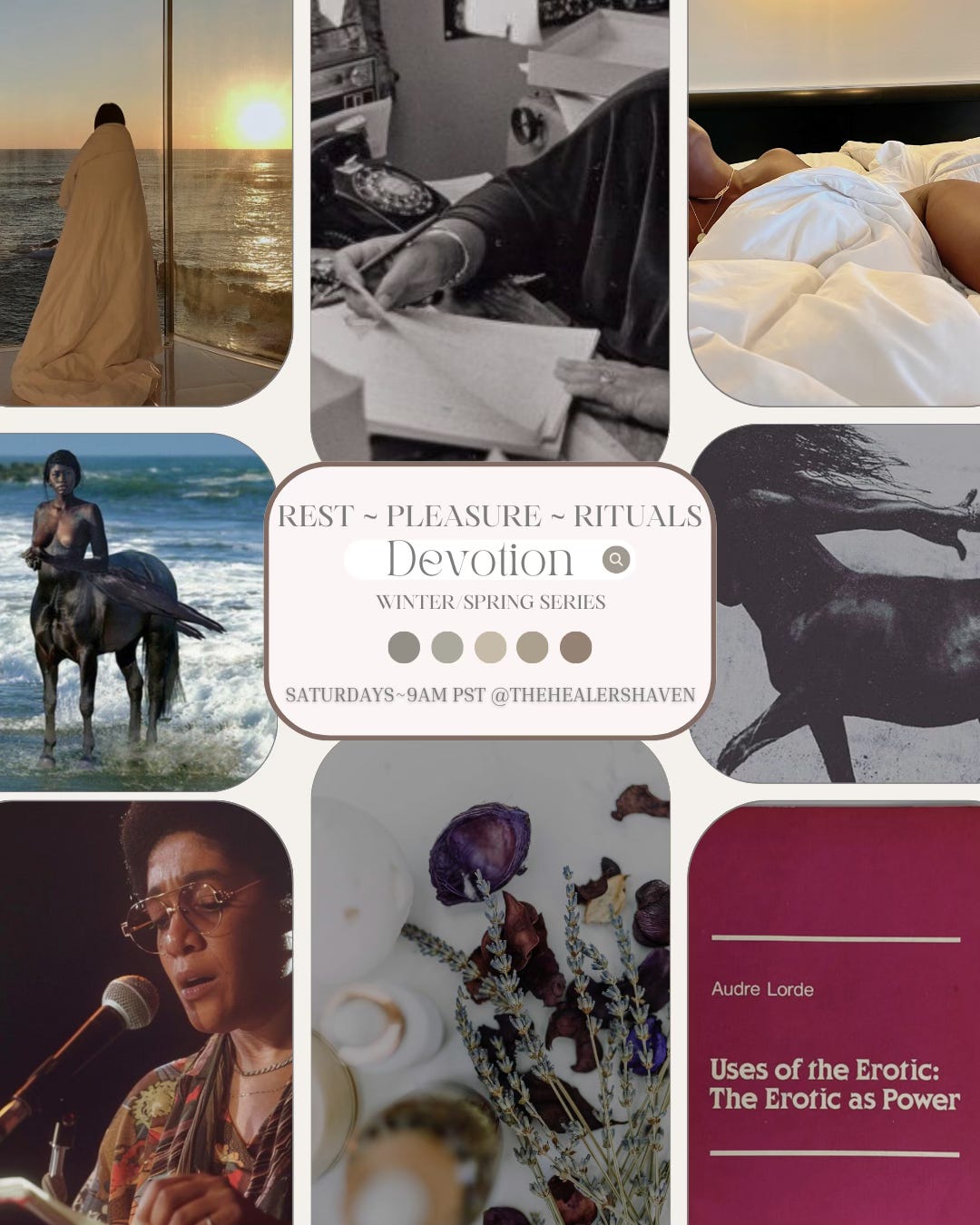
Spring is not cute. It is not pastel. It is rupture. Sap rising. Soil breaking. The return of circulation after winter’s containment.
The erotic is spring energy in the body.
It is what thaws you. What stretches you. What insists on more life. We are in a season of devotion that is asking a harder question than “What do you desire?” We are asking:
Do you trust what your body reveals when it feels deeply?
Do you recognize your aliveness as instruction?
Do you know the difference between stimulation and sovereignty?
This essay became our muse because Lorde refuses to let women confuse attention with authority, intensity with truth, or craving with destiny.
And from that devotion space, one of our private sessions unfolded.
It began with a hovering thumb over a blank text.
And it had everything to do with the erotic.
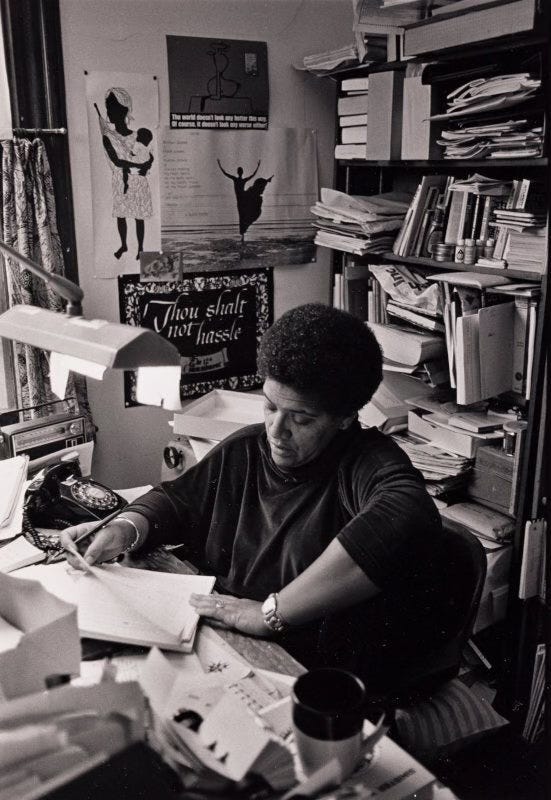
“I keep almost typing a name.”
I leaned in and said,
“Oh… this is rich. This isn’t about a person. This is about charge. Let’s peel it back without romanticizing it.”
They described the moment again: fingers hovering over the phone. Almost pressing send. Then stopping.
“That moment right there,” I said, “is dopamine anticipation. Not connection. Anticipation. The brain lights up before the reward ever arrives. The typing itself becomes ritual — a signal that something stimulating might happen.”
They paused.
“And then I hear myself say, ‘Don’t you dare.’”
Exactly.
Now we have two systems online:
The craving body — limbic, urgent, wanting expansion.
The regulating voice — prefrontal, discerning, watching.
“That inner ‘Don’t you dare’ isn’t repression,” I told them. “It’s awareness. There’s a pause between impulse and action. That pause is power.”
But the energy doesn’t vanish. It waits.Then they said something that shifted my whole being:
“I think I’m turned on by being turned on.”
There it is. Now we’re not talking about a name. We’re talking about aliveness.
I asked, “Is it the person? Or is it the longing itself?”
They sat with that.
Craving attaches to a face because the nervous system likes symbols. A human becomes a vessel for:
Erotic stimulation.
Intellectual friction.
Emotional possibility.
Chemical novelty.
But if the charge could transfer to anyone… then it’s not about the vessel. It’s about the state.
We crave altered states:
Arousal.
Validation.
Novelty.
Being seen.
Feeling alive.
The body remembers expansion. It wants that expansion again. Now here’s where it got sharp.
“You actually have three options when this charge rises,” I said.
“You can write it.
You can circulate it internally.
Or you can project it outward and wait for someone else to activate it for you.”
All three come from the same root: creative life force. Libido in its truest sense — vitality.
If you write → the energy becomes creation.
If you circulate it → the energy becomes embodiment.
If you project it → the energy becomes fixation.
Projection is the least efficient channel. You hand someone your voltage and wait for them to flip the switch. And that waiting? That’s where obsession forms. Unexpressed energy with nowhere to go.
They laughed and said, “So I either write… self-ignite… or spiral.”
I didn’t sugarcoat it.
“If you write and build charge without release, the nervous system will look for an outlet. That’s physiology. Erotic charge is creative charge. If it isn’t metabolized, it mutates.”
I don’t feel it’s because you’re weak. I believe, because you’re alive. And here’s the deeper cut. Underneath the craving is often something quieter:
The desire to feel chosen.
The desire to feel powerful in someone’s gaze.
The desire to feel mirrored intellectually.
The desire to feel expanded.
Or sometimes something brutally simple: ‘I want to feel alive.’ When life feels flat, erotic tension becomes oxygen. Now here is the question that actually matters.
It is not:
“Should I reach out?”
It is:
Where do you want to source your aliveness from?
External ignition? Or internal combustion? Because the truth is — you already generated the charge. No one handed it to you. That is sovereignty over stimulation. And this is where Lorde’s work slices through the noise. The erotic is not indulgence. It is information. It tells you what expands you.
What sharpens you. What awakens you.
The problem begins when you outsource that information to the nearest vessel and call it destiny. Sovereignty over stimulation is bigger than romance.
It is about:
How you eat.
How you scroll.
How you argue.
How you consume culture.
How you seek praise.
How you chase intensity.
Do you reach for stimulation because you are empty? Or do you choose stimulation because you are already full?
And here is the quiet truth I left them with:
When you can sit inside your own erotic voltage without leaking it toward the nearest body, you become magnetic in a way that has nothing to do with pursuit. That’s erotic discipline, nervous system maturity, and spiritual authority wrapped in one gift.

I asked one final question before we closed.
“Do you actually want the person… or do you want the version of yourself that wakes up when they’re near?”
They didn’t answer immediately. They didn’t need to. So I’ll leave you with the same inquiry.
When you feel that charge rising —
Is it love?
Is it hunger?
Is it boredom?
Is it brilliance trying to be born?
And most importantly:
What would change if you decided your aliveness belongs to you first?
Let’s talk.