
Session Notes:
An Aftercare Series on Rest, Rupture, and Releasing Inherited Harm


| This series lives in a moment of recognition.
Choosing what ends with us is not a rejection of family, culture, or history. It is an act of discernment. A willingness to look honestly at what no longer belongs in the body, even if it once kept someone else alive. It asks a harder question than “What do I need?” It asks, “What am I no longer willing to transmit?”
These essays are written from real client work—anonymized, shared with permission—and from the aftercare that follows transformation. They explore rest as indulgence, but as interruption. |
She wasn’t falling apart.
She was functioning too well.
Her life worked. On paper, at least. Her calendar was full. Her responsibilities were handled. Her people relied on her. She arrived articulate, self-aware, and tired in the way high-capacity women often are—tired, but still standing. Still performing. Still managing.
She frames her requests and prayers, carefully. ‘Better sleep. More energy.’ A way to feel less depleted without disrupting everything she had already built. She’s not asking to stop, she wants to optimize.
But her body tells a different story.

She’s not always aware of how her shoulders hover near her ears even while she smiles. Or how her breath stays high and shallow, as if rest is something she might fall into and not survive. She speaks quickly, efficiently, like someone accustomed to making good use of time, even sacred time.
What she doesn’t say, but her nervous system speaks so clearly, is:
Rest no longer feels like an option. Sometimes it actually feels like more of a threat. She learned, somewhere along the way, that stopping means that things might unravel. That stillness invites collapse. That if she isn’t holding it all together, no one would.
Not resting doesn’t always equate carelessness. She’s been needed for a very long time, so it can be easy to forget to be the best caretaker for herself.
Why do I talk about rest so much?
rest is where the truth shows up.
People can fake productivity. They can fake wellness. They can fake insight, language, even healing. But rest? Rest tells the truth every time. So when I encounter women, mothers, creatives, practitioners- caretakers, like her (above)- or even myself, we don’t begin our work together by resting.
This is important to say.
Rest is not the starting point for a system that has learned to survive through vigilance. Asking someone like us to “slow down” too soon would feel like asking us to step off a ledge without first checking if there was ground beneath us.
So instead, we start with permission.
Permission to arrive exactly as you are—productive, alert, braced. Permission to be witnessed without performing insight. Permission to not know what comes next. Because don’t you see?, we’re always expected to know- we were born to anticipate the next best move, the emotion, the outcome. The medicine here is trusting our ability to not know.
Through Soulstream™, I respond less to stories like hers- and mine; and I focus more on patterns. Where energy is rushed. Where it is stalled. Where the body first learned to override its own signals in service of continuity. How would you classify these internal systems? Broken or loyal? I would say- intensely loyal- to a version of safety that requires constant participation. In other words, no rest.
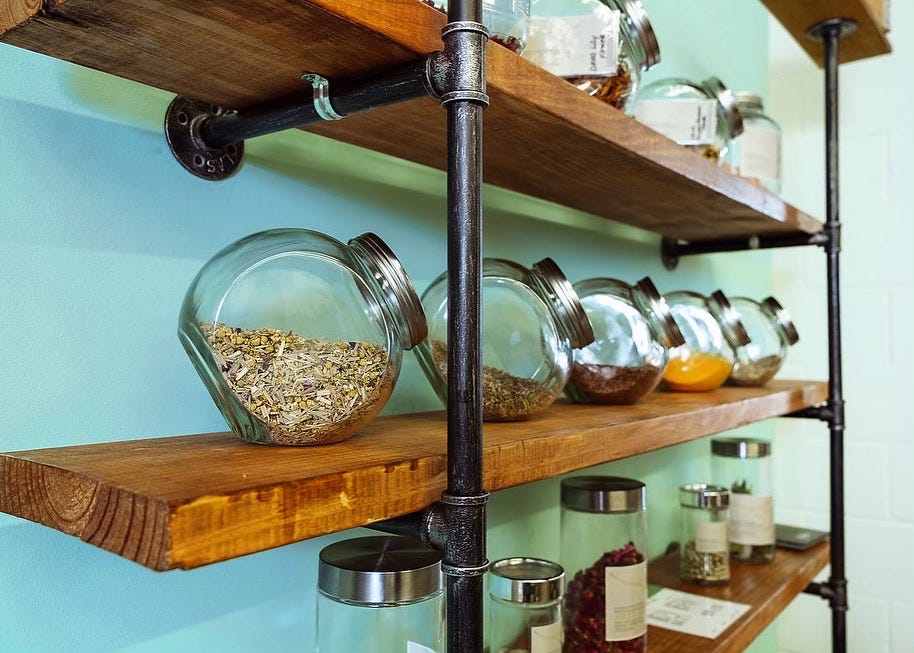
Through HERBLAB™, I support the body not by forcing calm, but by building capacity. Much like I would do for myself. Gentle nervous system tonics. Mineral replenishment. Ritualized nourishment that doesn’t ask us to “fix” ourselves—only to receive. This is such resonant, yet unfamiliar territory. Being fed without earning it- can make givers like us uncomfortable at first.
Which brings us to ceremony. Not the dramatic kind; but the quiet, precise kind. Small rituals mark transitions for the body that- on our own- some of us would never allow ourselves to complete. Like, closing loops. Naming endings. Creating moments where nothing was required of us except presence. At first, the system might resist. I’ll see clients that fidget. Check the time repeatedly. Apologize for not relaxing “correctly.” Or just plainly begin looking for a way out- and back to what feels familiar.
That’s when I know we’re touching the truth.
The invitation remains: to no longer confuse endurance with safety or mistake exhaustion for proof of worth. So we slow down—not just because slowness is holy, but because our bodies need evidence that nothing bad will happen if/when we do.
The shift doesn’t arrive all at once. It never does. It may even arrive sideways.
She stops explaining herself as much. Not dramatically, just less. She begins to notice when her jaw tightens before she agrees to something. She cancels one obligation without replacing it with another and sits in the discomfort long enough for it to pass. Her sleep doesn’t magically become perfect. But she stops fighting wakefulness like it is a personal failure. She listens instead. Adjusts. Responds.
One day, almost casually, she mentions that she has taken an afternoon off and hasn’t spent the entire time feeling guilty about it. This is when we both pause here. Because this is the miracle. Not rest as a performance. Rest without justification.
Her body softens in ways she hasn’t predicted. Digestion improves. Headaches lessen. The constant low-level anxiety she has normalizes and begins to loosen its grip. Perhaps because her system no longer believes it was alone in holding everything together. The space between feeling less capable or less burdened becomes realized.
Working with her changed me, too. Connecting with clients, mothers, women, caretakers, creatives, and practitioners like this changes me because this work is reciprocal initiation, not service delivery.
Rest is not individual—it’s ancestral
For many of us, rest was never neutral. In Black families, immigrant families, religious families, working-class families, and survival-shaped lineages, rest was coded as:
laziness
entitlement
danger
moral failure
abandonment of duty
Rest was allowed only after exhaustion proved your loyalty. So when a woman chooses rest now—real rest, not aesthetic rest—it doesn’t just soothe her nervous system. It interrupts a contract that has been running for generations. I feel changed because I am witnessing a rupture in a lineage agreement. And my body recognizes it.
Visiting home for the holidays reminded me so clearly of the assumption being made about my life: individuality is a luxury. I recognize the lineages within my own bloodline that survived by proximity, obligation, and silence.
To say:
“I need space”
“I’m not available”
“I choose ease”
“I won’t carry this anymore”
Is not just preference. It was and IS interpreted as violence. Because it threatens the structure that keeps everyone afloat. So for generations born after the boomers- those of us labeled as more sensitive, more attuned, more emotionally literate, rest isn’t frowned upon because it’s wrong.
It’s frowned upon because it breaks the math.

I am changed because I am watching someone do what I am also being asked to do.
When a client chooses softness without permission, my system takes notes. Somatically. My body registers and my children register:
“Oh. That’s allowed.”
And then it asks me, quietly but firmly:
“Where am I still performing loyalty through depletion?”
I like this work of lineage resonance. Where I’m not drained by this work, but I feel re-educated.
This culture loves simple conclusions. This work refuses them.
We live in an era addicted to shortcuts:
“If you rest, you must be privileged.”
“If you say no, you must not care.”
“If you slow down, you must be disengaged.”
“If you choose yourself, you must be selfish.”
These assumptions are cheap. They require no intimacy, no context, no listening. But I work from here:
“This choice doesn’t have a reference point yet—but my body knows it’s true.”
This kind of decision-making costs something. Reputation. Approval. Familiar belonging. And I know too many people, like myself, that have paid that cost and even compromised using their gifts freely because of it.
So here’s the part I’m naming that matters most
At some point, we have to stop narrating the limitations of our families and culture as if they are external weather systems. Not in blame. In responsibility. Because every time a woman chooses rest without precedent, she widens the field. And when the field widens, everyone inside it breathes differently, including me.

Thank you for being here.
If you see yourself in her story or our story, know this:
You don’t need to earn rest by breaking down first.
You don’t need to justify your exhaustion with a crisis.
You don’t need to disappear to deserve relief.
This work—whether through Soulstream™, HERBLAB™, ceremony, or Ritual Frameworks—is for those who are high/low-functioning and quietly depleted. For those whose lives look “fine” but feel heavy. For those who sense that their bodies are asking for something deeper than another productivity hack or wellness trend. Rest is not something you schedule once everything is done. It’s something your body remembers when it finally feels safe enough to let go. And sometimes, remembering begins simply, with being witnessed.
Kira!! This was a beautiful writing & reflection for myself. As an Indigenous teaching REST as medicine and a necessity for our lineages moving forward, this was very validating and affirming knowing there are other women out here doing the damn thing.
I loved the opportunity to explore myself through "Her" that you depicted so clearly. It's beautiful being in a life with the space and knowing that rest is essential and it is simultaneously heart breaking traversing through life with family and community know nothing but survival. The way showers, the ones who remember. We are them. Stay in your light, you are doing it sis!